
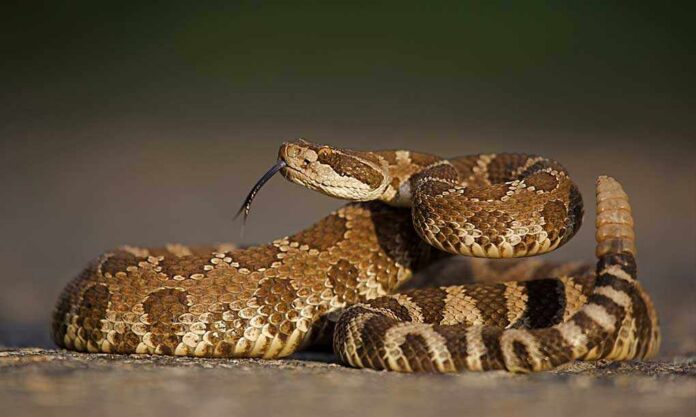
The unsettling story of a three‑year‑old bitten by a rattlesnake hiding under an Amazon package is less a bizarre anomaly than a sharp reminder of how modern suburban life and wildlife now overlap in ways most people simply do not prepare for.
Key Points
- The Santa Clarita case, while based primarily on a father’s account, aligns with documented rattlesnake behavior and prior “snake and package” incidents in California.
- Southern Pacific rattlesnakes are common in the Los Angeles–Santa Clarita region and readily use shade, objects, and human clutter as cover.
- Rattlesnake season, delivery growth, and expanding suburbs together increase the odds of close encounters in yards, play areas, and around packages.
- Most snakebites are preventable with simple environmental precautions and clear family protocols for kids, parents, and delivery areas.
What We Actually Know About the Santa Clarita Bite
In the Santa Clarita case, the core narrative is straightforward: a three‑year‑old girl, Addy, ran out to retrieve an Amazon package left just inside the gate of her family home and was bitten by a rattlesnake that had tucked itself beneath the padded brown envelope. According to her father, Manuel Barajas, the snake was identified as a Southern Pacific rattlesnake, a species that is both common and medically significant in Southern California. Emergency care involved multiple doses of antivenom and a transfer to a pediatric intensive care unit, consistent with treatment protocols for serious rattlesnake envenomation in young children.
Unlike many social‑media‑driven scares, this story is not floating in a complete vacuum. Local TV outlet KTLA reported the incident, providing a coherent timeline, approximate location (Santa Clarita), the species involved, and hospital care details that match established medical practice for rattlesnake bites. At the same time, there are limits. The public record does not yet include medical documentation, wildlife agency confirmation of species, or a law‑enforcement incident report, so most of what we “know” still comes through the lens of family testimony and media retelling.
Those evidentiary gaps matter if you are trying to reconstruct the event minute by minute, or assign liability. They matter less for the larger question this case throws into relief: could a rattlesnake plausibly be hiding under a delivered package in a Santa Clarita yard, and could a small child be bitten before ever seeing it? On that question, the ecological and behavioral evidence is clear: yes, it is entirely plausible.
Rattlesnakes in Suburbia: Why This Scenario Is Plausible
Southern Pacific rattlesnakes (Crotalus oreganus helleri) are the default rattlesnake in much of coastal and foothill Southern California, including Los Angeles County and the Santa Clarita Valley. They occupy chaparral, grassland, rocky slopes, and—crucially for this discussion—edges of urban and suburban development, where irrigated landscaping, rodent populations, and artificial cover (from lumber piles to playground equipment) create viable microhabitats.
Behaviorally, rattlesnakes are ambush predators and consummate opportunists when it comes to shade and concealment. They shelter under boards, rocks, landscape debris, play equipment, and any object that creates a cool, hidden space just off the ground. Wildlife and safety agencies routinely warn residents to be cautious when reaching around woodpiles, moving patio furniture, or stepping near objects that have been sitting undisturbed. A padded shipping envelope dropped in a sunny yard, especially against a fence or gate where rodents may move, is a perfectly reasonable candidate for a temporary hide.
The Santa Clarita region has a long history of rattlesnake encounters. Local experts and agencies note that rattlesnake season in the Los Angeles area typically runs from spring through early fall, with the Southern Pacific rattlesnake the species most often involved. Regional guidance emphasizes exactly the pattern we see here: snakes are not actively “hunting” people, but they will defend themselves when suddenly disturbed at close range—often when someone puts a hand or foot where the animal cannot see them coming.
In that light, a three‑year‑old reaching down for a package without scanning the ground is precisely the sort of blind contact scenario that produces bites. The mechanism is textbook, even if the specific object—an Amazon envelope rather than a rock or toy bin—is a product of modern logistics rather than wilderness.
“Snake-in-Package” Incidents: Rare, But Not Fiction
It is tempting to file this story under “too sensational to be true.” Yet there is an emerging pattern of snake encounters linked to mail and deliveries. In 2024, a man picking up a package at a Mojave Desert post office discovered a live Western rattlesnake inside the parcel itself; the animal had survived transit and was ultimately identified as a Northern Pacific rattlesnake, a close relative of the Southern Pacific species. In other cases, delivery drivers in Florida and elsewhere have been bitten by rattlesnakes coiled near doorways or packages they were setting down, showing the same convergence of human movement, packages, and opportunistic snakes.
These events are rare enough that no agency tracks “package-origin snakebites” as a distinct category, but the handful of documented cases demonstrate two points clearly. First, snakes will use human objects—including boxes, mail tubs, and porch clutter—as incidental shelter given the chance. Second, the logistics footprint of delivery services places people and packages precisely in the liminal spaces—gates, doorsteps, low walls—where snakes already patrol for shade and prey.
From a risk perspective, what happened to Addy is not a statistical norm; California records only a few hundred rattlesnake bites statewide each year, with relatively few fatalities given modern antivenom and emergency care. But rarity at the population level is cold comfort to the families who happen to intersect with that small probability. The case matters less as a mystery to be debunked and more as a vivid illustration of how extreme but plausible scenarios emerge when wildlife habitat and human routines intersect.
Media Incentives, Evidence Gaps, and How to Read Stories Like This
The principal weakness in the public record around the Santa Clarita bite is not the ecological plausibility—it is the thinness of independent verification so far. We do not yet have hospital records confirming the specific venom type, an official wildlife report documenting the snake’s capture and identification, or on‑record statements from Amazon about the delivery in question. That absence leaves the narrative leaning heavily on one family’s experience, filtered through an outlet whose business model rewards fear‑driven headlines.
This is where readers must hold two thoughts at once. On the one hand, there is no credible counter‑narrative: no agency, hospital, or neighbor has come forward to say the event did not happen, or to offer a sharply different account. On the other hand, the lack of primary documents or corroborating detail means this specific case should not, by itself, be treated as a settled template for liability, frequency, or Amazon‑specific risk.
The broader lesson is methodological rather than emotional. When confronting a story that touches both parental fear and corporate reputation, ask four questions. Is the mechanism plausible given independent ecological and medical evidence? Are there past, documented analogues that show the scenario is not purely invented? Do the numbers—bite incidence, species range—line up with the claimed setting? And finally, who benefits from framing this as a shock story rather than as a safety case study? In the Santa Clarita episode, the answers largely support plausibility while also revealing how much is still unknown about the exact chain of events.
Santa Clarita. 2nd alarm brush fire at Center Pointe Pkwy and Ferry Court. #PointeFire. Preschool sheltering in place on Golden Triangle. E143 en route to assess needs and for situational awareness. pic.twitter.com/2QoBiSUTYC
— LA Fire Alerts (@LAFireAlerts) July 15, 2026
Southern Pacific Rattlesnakes: Biology, Venom, and Why Kids Are Vulnerable
Understanding the animal involved helps clarify both the danger and the appropriate response. The Southern Pacific rattlesnake is a heavy‑bodied pit viper with a triangular head, cryptic brown or black patterning, and a reputation among herpetologists for particularly complex venom—some regional populations show potent neurotoxic and hemotoxic components. The species ranges throughout Southern California’s coastal and foothill counties, including Los Angeles and Santa Clarita, and is well adapted to human‑modified landscapes.
Children are at special risk for two reasons. First, their smaller body mass means a given volume of venom produces more severe systemic effects: swelling, pain, coagulopathy (blood‑clotting disturbances), and, in serious cases, cardiovascular instability or organ damage. Second, young children move quickly and close to the ground, with less situational awareness. A toddler sprinting toward a package or toy, eyes fixed on the prize, can cover the last few feet without ever scanning for a coiled snake under the object.
Despite their fearsome reputation, rattlesnakes do not seek out humans. Most bites occur when the animal is surprised or feels cornered—stepped on, grabbed, or approached within striking range before it can retreat. Many will rattle as a warning, but not all; some remain silent, especially when disturbed at very close range. That unpredictability reinforces a simple rule in snake country: avoid putting hands and feet where you cannot see clearly.
From Headline to Household: Practical Lessons for Families
For families in regions where rattlesnakes live—and that includes much of the western United States—the real value of the Santa Clarita story lies in the practical adjustments it suggests. Start with the environment. Snakes gravitate toward cover, clutter, and prey. Clearing dense brush, trimming vegetation away from walkways, securing trash and pet food to deter rodents, and avoiding wood or rock piles near high‑traffic play areas all reduce the appeal of your yard as snake habitat.
Next, consider how and where packages are delivered. If possible, designate drop‑off locations that are visible from inside the house and away from dense vegetation or low crevices. In snake season, get in the habit of visually scanning the ground and the space under or around boxes before children are allowed to dash out and grab them. Something as simple as an adult stepping out first, pausing to look from a safe distance, and then inviting a child to follow can drastically lower the risk of a surprise encounter.
Education is equally important. Age‑appropriate instructions—“If you ever see a snake, stop, step back, and call an adult; never touch it”—should be as routine for children in snake country as “look both ways before crossing the street.” Recent incidents in Santa Clarita preschools, where children spotted rattlesnakes in playhouses and alerted teachers who called professional handlers, demonstrate how effective that training can be when it is taken seriously.
Finally, every household in snake country should understand the medical playbook. If someone is bitten by a suspected rattlesnake, the priorities are straightforward: call emergency services, keep the person as calm and still as possible, remove constricting jewelry or clothing near the bite, and get to a hospital quickly. Do not cut the wound, attempt to suck out venom, apply a tourniquet, or pack the area in ice; these outdated measures waste time and can worsen tissue damage. Modern antivenom, given promptly in an appropriate facility, has transformed rattlesnake bites from frequently fatal events into serious but usually survivable emergencies.
Why Stories Like This Will Keep Appearing—and How to Respond
As metropolitan regions push deeper into former wildlands and delivery culture continues to grow, the interface between people and wildlife is only going to become more intricate. Rattlesnakes, coyotes, mountain lions, and other adaptable species will continue to exploit the new ecologies we create around our homes and schools. The Santa Clarita rattlesnake under a package is not an omen of a new, exotic threat; it is a predictable outcome of familiar trends.
The challenge for residents, parents, and policymakers is to move beyond the adrenaline spike of a sensational headline toward a stable, informed coexistence. That means respecting the real hazard these animals pose without exaggerating it into paralysis, investing in public education about avoidance and response, and designing our built environments—down to where the delivery driver sets a box—so that a child’s everyday excitement does not intersect with a snake’s instinctive need for shade and surprise.
Sources:
nypost.com, theguardian.com, abcnews.go.com, cbsnews.com, kiro7.com, tcpalm.com, weartv.com, youtube.com, hometownstation.com, thesnakeschool.com