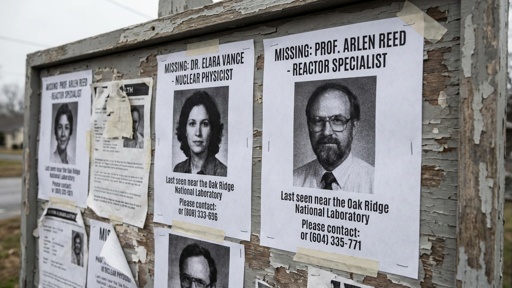
Eight individuals connected to America’s most classified nuclear, space, and missile programs have vanished or died under circumstances that defy simple explanation, and the pattern emerging from their cases raises questions that cannot be dismissed as mere coincidence.
The Disappearances Begin in the Desert Southwest
Frank Maiwald, a NASA-affiliated scientist at Jet Propulsion Laboratory, died in Los Angeles on July 4, 2024, at age 61. His work specialized in advanced space instrumentation and planetary detection systems, including research on identifying signs of life on Europa and Enceladus. No cause of death was disclosed. No autopsy was conducted. The case initially drew little public scrutiny, yet it marked the beginning of a sequence that would expand into a documented cluster of missing and deceased scientists with access to America’s most sensitive defense technologies.
On May 4, 2025, Anthony Chavez, a former Los Alamos National Laboratory employee with access to sensitive nuclear and classified technology research, disappeared while walking in New Mexico. His phone and wallet were never found. No confirmed sightings followed his disappearance. The case remains quietly unresolved, fitting a pattern that would become increasingly difficult to ignore as additional scientists vanished under strikingly similar circumstances in the months ahead.
Someone want to explain to me about the scientists tied to NASA and Los Alamos found dead or missing?
Nearly all of them worked together — and died or vanished within the last two years from what I am seeing.🤔 pic.twitter.com/3aQaqjBFr4— Squirrel Operator (@Blankshine_IRL) April 8, 2026
Senior Engineers Vanish Without a Trace
Monica Jacinto Reza vanished on June 22, 2025, while hiking near Mount Waterman, California. A senior aerospace engineer and former Technical Fellow at Aerojet Rocketdyne, Reza was a leading figure in advanced rocket propulsion materials. She co-invented a nickel-based superalloy for next-generation engines designed to reduce foreign propulsion dependence. An extensive search lasting until June 30, 2025, involving helicopters, drones, and canine units, yielded no trace of her. The disappearance of someone with her level of expertise and access to classified propulsion systems represents a significant loss to U.S. defense capabilities.
Four days later, on June 26, 2025, Melissa Casias, an administrative professional at Los Alamos National Laboratory with access to high-security scientific environments, was last seen walking on State Road 518 in New Mexico. Behavioral details noted as unusual included leaving home without essential belongings and being spotted miles away alone. The geographic clustering in New Mexico and the Western United States, combined with the institutional connections to Los Alamos National Laboratory, creates a pattern that stretches the boundaries of statistical coincidence.
A Retired General Disappears
Retired Air Force General William Neil McCasland vanished without a trace on February 27, 2026. McCasland commanded the Air Force Research Laboratory and oversaw advanced space and defense programs. His seniority and background in classified aerospace programs add layers of complexity to an already perplexing series of events. The disappearance of a retired general with his level of knowledge and connections represents not just a personal tragedy but a potential national security concern. Monica Reza and William McCasland shared professional connections through advanced propulsion and Air Force research structures, despite working in different organizations.
The convergence of timelines, professional backgrounds, and unusual circumstances raises questions that cannot be fully explained by coincidence alone. Multiple disappearances occurred during outdoor activities without phones or tracking devices. The concentration among individuals with access to highly classified research, combined with geographic clustering in the Western United States and involvement with institutions like Los Alamos National Laboratory and advanced propulsion research, creates a profile that demands scrutiny rather than dismissal.
The Pattern That Authorities Won’t Acknowledge
Gaps in transparency leave room for possibilities that have yet to be explored or disclosed. The absence of disclosed causes of death, autopsy results, and official statements creates information gaps that fuel legitimate questions rather than idle speculation. A closer examination reveals a mix of genuine mysteries, crimes, and ambiguous deaths, all increasingly woven together by a narrative that moves faster than verified evidence. Yet the real overlaps, including institutional connections, behavioral similarities, and geographic clustering, cannot be dismissed as mere paranoia or conspiracy theorizing.
The defense and aerospace research ecosystem operates as a closed network where information flow is restricted and transparency is limited by design. This creates an environment where institutional knowledge resides in a small number of highly specialized individuals. The loss of senior researchers and engineers with access to classified propulsion systems, nuclear research, and advanced aerospace technology represents potential gaps in institutional knowledge and capability that may take years to rebuild. The concentration of disappearances among individuals with access to classified technologies raises fundamental questions about security protocols, personnel protection, and institutional oversight.
National Security Implications and Unanswered Questions
Limited transparency from authorities regarding these cases may erode public trust in government institutions and their ability to protect personnel working on the most sensitive defense programs. Uncertainty surrounding the safety of scientists in these fields could impact recruitment and retention of talent in critical defense and space research sectors. The American public deserves accountability and transparency when individuals entrusted with our most classified secrets vanish under unexplained circumstances. The reluctance of authorities to acknowledge any pattern or provide detailed information only deepens suspicion and concern.
The families of missing and deceased individuals deserve answers. The scientific and engineering communities in defense and aerospace sectors deserve assurances about their safety. U.S. military and intelligence agencies owe the American people an explanation for why personnel with this level of security clearance and institutional knowledge are disappearing without comprehensive investigations and public accountability. The convergence of cases involving Los Alamos National Laboratory, the Jet Propulsion Laboratory, Aerojet Rocketdyne, and the Air Force Research Laboratory cannot be ignored simply because the truth may be uncomfortable or inconvenient.