
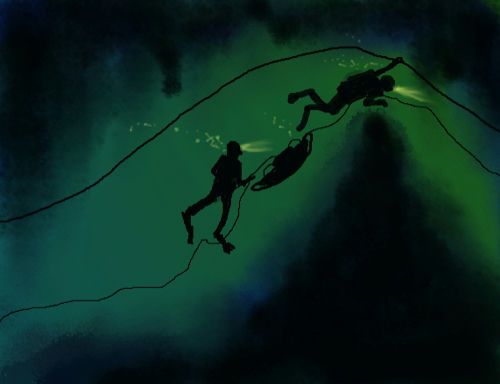
A deadly dive in a Maldivian sea cave is exposing how gaps in safety, oversight, and honest communication can turn an elite “research expedition” into a preventable mass-casualty event.
Story Snapshot
- Five Italian divers and one Maldivian military diver died during a cave dive near Vaavu Atoll, shocking the global diving community.
- Finnish recovery divers now suggest a “sand wall illusion” at the cave entrance misled the team into a deadly wrong tunnel.
- Experts also point to possible gas or equipment issues, showing no single, definitive cause has been proven.
- The case highlights how complex technical disasters can be obscured by silence, bureaucracy, and competing narratives.
A Fatal Cave Dive That Raised More Questions Than Answers
Witness reports and early coverage agree that five Italian divers died while exploring an underwater cave near Alimathaa, a popular dive site in Vaavu Atoll, during what was described as a marine research expedition.[1] Authorities later confirmed that the bodies of four missing Italians were eventually located deep inside the cave system at roughly one hundred sixty feet, with a sixth victim, a Maldivian military diver, dying from decompression sickness during recovery efforts.[2][3] The tragedy quickly became one of the deadliest diving accidents in Maldives history.
Investigations and media reports described the group descending far beyond the usual recreational limit of about ninety-eight feet in Maldives before entering a complex cave network.[1] Recovery teams, including three specialist Finnish cave divers, needed several days to remap the site and safely retrieve the bodies.[3] The depth, overhead environment, and the need for staged decompression meant each attempt carried significant risk, underscored by the loss of the Maldivian rescuer who succumbed to decompression illness after earlier efforts.[2]
The “Sand Wall Illusion” Theory From Finnish Recovery Divers
Finnish cave divers brought in for the recovery have since described a striking optical and environmental trap at the cave entrance, now dubbed a “sand wall illusion.” Their reconstruction suggests that suspended sand and silt, combined with the geometry of the cave, can create what appears to be a solid wall, hiding a safe exit tunnel while making a dead-end passage look like the correct route.[3] The fact that all four missing Italians were found deep inside the system aligns with a navigation error rather than a surface emergency.[3]
Cave-diving safety literature and experienced instructors have long warned that disorientation, silt-outs, and guideline loss are leading killers in overhead environments, often more decisive than sheer depth or gas toxicity. In this case, Finnish divers’ schematic descriptions suggest the team may have followed what looked like an open continuation, only to become trapped in a narrowing, sand-choked branch as visibility collapsed. That scenario would explain why even skilled divers, reportedly on a research mission, might be lured farther from daylight and lose their way home in seconds.
Alternative Explanations: Gas Mixes, Panic, And Equipment Responsibility
Italian medical experts analyzing the case from afar have raised a different possibility: that something in the breathing gas or tank management played a critical role. A pulmonologist quoted in Italian media argued that five fatalities on one dive suggest “not so much a depth problem, but rather what they breathed,” pointing to a possible issue with the gas mixture in the tanks and emphasizing that quality checks are the responsibility of those who produce and manage equipment.[2] Another specialist mentioned hyperoxic crisis from an inadequate gas blend as a plausible factor.[2]
These medical voices also highlighted how panic can magnify any technical fault inside a cave at around one hundred sixty feet.[2] A single diver experiencing distress or equipment failure could trigger confusion, rapid breathing, and poor decisions for the entire team in a tight overhead space. That line of thinking does not directly contradict the “sand wall illusion” mechanism; instead, it suggests a compound failure where disorientation, possible gas issues, and human stress all converged. Yet, without a comprehensive public forensic report, the balance between these factors remains uncertain.
Silence, Risk, And The Public’s Growing Distrust Of “Experts”
Survivors’ families have publicly demanded clearer answers, frustrated that weeks of investigation produced more speculation than hard explanation.[2] Diving commentators have criticized what they call a “cost of silence,” arguing that when governments, industry, and training agencies keep technical details behind closed doors, the public is left with rumors instead of lessons that could prevent the next tragedy. That frustration mirrors a broader distrust many Americans feel toward institutions that seem more protective of reputations and liability than of ordinary people’s safety.
Finnish divers believe ‘sand wall illusion’ caused deadly Maldives cave disaster
Recovery team says five Italian divers may have mistaken a dead-end tunnel for the exit after a sandbank hid the correct corridor; GoPro cameras recov…https://t.co/g8CbxAq8Ux pic.twitter.com/Qm5OwDnssf
— Ynet Global (@ynetnews) May 21, 2026
Global tourism and diving are highly regulated on paper, but enforcement and transparency vary widely. This Maldives case shows how quickly a “world-class” destination can become the scene of a complex disaster where accountability is hard to pin down. Families want to know who signed off on dive planning, gas checks, cave experience, and emergency protocols—and why clear answers are still missing. When institutions respond with partial data and vague assurances, it reinforces the sense that elites close ranks while regular people bear the risk.
Sources:
[1] Web – Five Italian divers die in Maldives cave – DIVE Magazine
[2] YouTube – Bodies of 2 missing Italian divers recovered in the Maldives
[3] Web – CCR recovery divers locate all 4 bodies in Maldives cave – Divernet